



A chargeback is a formal dispute raised by a cardholder through their issuing bank, looking to reverse a transaction. Each card scheme (this means Visa, Mastercard etc) operates their own chargeback rules, but they’re all very similar. Chargebacks are designed to protect customers from fraud or errors, but they can also result in lost revenue and additional fees for your business. Before we explore ways to reduce the risk and the impact of chargebacks, we’ll help you to understand the end-to-end process and players.
Search our help centre
Chargebacks
Simplifying chargebacks
Your guide to understanding, preventing and managing payment disputes.
- Cardholder: the customer disputing the charge.
- Issuer: the cardholder’s bank.
- Merchant: that’s you, the business accepting card payments.
- Acquirer: your payment processor (in our case, Elavon).
- Card scheme: network facilitating the transaction (e.g. Visa or Mastercard)
Technically, only a card issuer can initiate a chargeback via the relevant card scheme. There are two reasons they might: because a cardholder has asked them to, or because they are protecting themselves against financial loss. The latter cases are usually related to invalid authorisations and often, these happen without the cardholder knowing.
The transaction flow
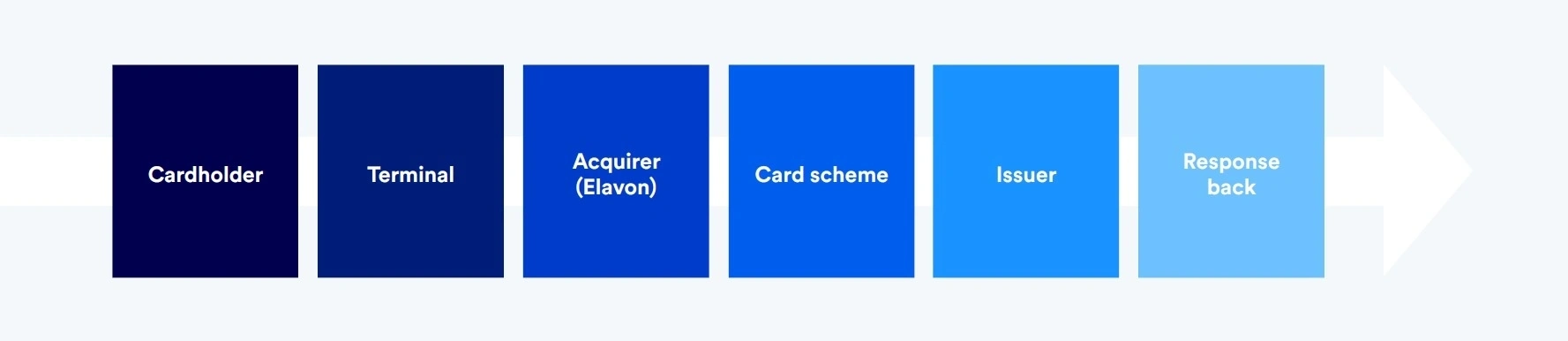
When a card is used to pay for anything, the transaction request passes through several steps and organisations, all shown in the diagram above, and all in just a few seconds. If approved, the funds are transferred out of the cardholder’s account, through the flow, into your merchant account.
A chargeback reverses this process, taking the original transaction and pushing it back through the flow, in the other direction.
Chargebacks are usually opened because a card was used fraudulently, a customer was dissatisfied with the service or product they purchased, or because there has been an administrative error or a policy misunderstanding.
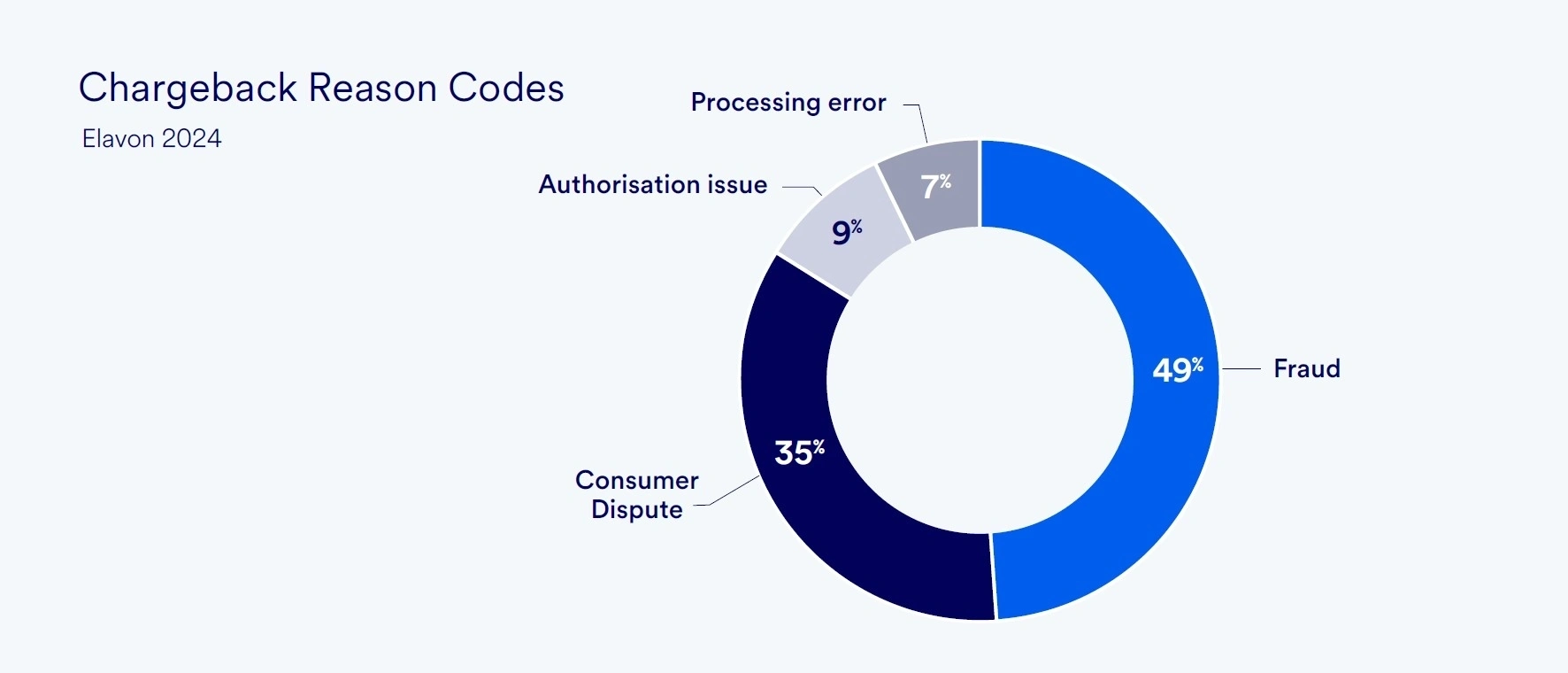
Chargebacks are grouped into four main categories using reason codes.
- Fraud: card was used without authorisation
- Consumer dispute: item paid for was not received, or it was defective
- Processing error: transaction processed as duplicate or incorrect amount
- Authorisation issue: improper or missing approval
You’ll find a full list of chargeback reason codes and supporting documents here.
Even with robust and accurate sales record keeping and helpful, expert support from your acquirer, you’ll want to avoid chargebacks if you can.
Here are a few things you can do to make your payments more secure and minimise the likelihood that a customer needs to initiate a chargeback.
- Always use secure payment methods (like Chip & Pin, 3D-secure).
- Clearly display and signpost your refund return policies, and any Ts & Cs.
- Provide excellent customer service, accessible contact details and timely responses.
- Issue refunds promptly once agreed, so that customers don’t need to escalate.
- Keep thorough sales records, receipts and proof of delivery. The onus is on merchants to provide evidence that the customer has no right to dispute a transaction.
Each reason code requires different documentation to be provided in your response, and some business types are required to respond differently.
Here you’ll find a summary of reason codes, plus further guidelines to help you respond in the best way.
It’s important that you respond quickly to every case you disagree with, so we can represent you effectively. Here are the tasks you need to complete.
- Review the chargeback notice sent by Elavon.
- Gather evidence: receipts, terms, delivery confirmation, emails.
- Respond promptly via Elavon connect email (chargebacks@elavon.com).
- Follow guidelines specific to the reason code.
- Monitor updates through Elavon connect.
If a chargeback can’t be resolved, it becomes governed by the card schemes’ Arbitration Committee. There are no strict deadlines associated with this process, and an Arbitration fee in excess of €500 might be charged by the card scheme and passed through to you as the merchant.
When is a dispute not a chargeback?
There are a number of processes linked to disputed transactions, other than chargebacks, which you may be asked to respond to. To avoid escalation, you should always respond quickly and with all the relevant evidence.
Retrieval process
This is a request for documentation, usually a signed receipt or itemised invoice, which might precede a chargeback.
Good Faith process
Card associations are not involved in this process. This is a voluntary request for funds which can be initiated by either acquirer or issuer, and neither are mandated to respond. This may or may not be linked to a full chargeback.
Compliance process
A bit like Good Faith, this process can apply in situations which are not subject to chargeback rules or don’t meet the reason codes. In this case, if the issuer and acquirer can’t agree, the card scheme can step in to decide an outcome.
Usually, chargebacks must be filed within 120 days of the transaction or expected service date, while some extend to 540 days in special cases (e.g. travel, postponed services). This can vary by card scheme and reason code, so make sure you check which applies to you. Chargebacks can be resolved within a few days, or many months. Importantly, missing the deadline means an automatic loss.
There are some admin costs associated with chargebacks, including a fee per chargeback, which is outlined in your Elavon contract, plus an Arbitration fee if resolution isn’t agreed and the card scheme has to step in.
In addition, your business can lose revenue when refunding goods and services within the chargeback request. Too many chargebacks might impact your status as a merchant, and if this leads to disappointed customers, could have a negative impact on your reputation.
The first thing you’ll receive is an encrypted email from the Elavon Chargebacks Team. It’s a good idea to check that sure your email system can receive and open encrypted messages, and details on how to open this type of mail can be found here.
Remember that we only use one email address per business, for any communications related to chargebacks, so please make sure your business email address is the right one and is kept up to date. You’ll also be alerted through our customer service platform, Elavon Connect and you can see an example of this below.
Issuing banks make a data informed decision to approve or decline a transaction. The authorisation code is a number provided by the issuer bank during the transaction, confirming that the card is valid, that sufficient funds are available at that time and that the transaction is approved.
No, only issuers can open a chargeback, either for themselves or when requested by a cardholder.
No. Usually, Fraud codes are used when cardholder details have been compromised, and there can be other reasons. It’s not immediately an accusation that your business has done anything wrong.
Yes, but remember that anything you discuss outside of the process might not be usable as evidence, nor provide an official resolution.
A refund is initiated by the merchant, while a chargeback is initiated by the issuing bank.
Although they share a similar name, cashback and chargebacks have nothing in common. Cashback is an option on your terminal whereby a cardholder can pay with a card in return for cash from the merchant.
PCI DSS is not related to chargebacks. PCI DSS ensures that data is processed and stored safely, while chargebacks are related to services and correct processing.
No, once a chargeback has been started, you should follow the process to the end.
Simplifying chargebacks guide

Helping thousands of customers around the world grow their business through payments
Customer service and support
We’re here to help!
Customer service: 0345 850 0195 (menu option 2)
Telephone: Monday to Friday 8am-5pm
Chat: Monday to Friday 8am-6pm
Elavon technical support: 0818 20 21 30 (menu option 1)
24 hours a day, 365 days a year
Opayo product support: 0191 313 0299
24 hours a day, 365 days a year
Copyright© | U.S. Bank Europe DAC. Registered in Ireland with Companies Registration Office. The liability of the member is limited. United Kingdom branch registered in England and Wales under the number BR022122.
U.S. Bank Europe DAC, trading as Elavon Merchant Services, is a credit institution authorised and regulated by the Central Bank of Ireland. Authorised by the Prudential Regulation Authority. Subject to regulation by the Financial Conduct Authority and limited regulation by the Prudential Regulation Authority. Details about the extent of our regulation by the Prudential Regulation Authority are available from us on request.
Helping thousands of customers around the world grow their business through payments
Customer service and support
We’re here to help!
Customer service: 0345 850 0195 (menu option 2)
Telephone: Monday to Friday 8am-5pm
Chat: Monday to Friday 8am-6pm
Elavon technical support: 0818 20 21 30 (menu option 1)
24 hours a day, 365 days a year
Opayo product support: 0191 313 0299
24 hours a day, 365 days a year


Copyright© | U.S. Bank Europe DAC. Registered in Ireland with Companies Registration Office. The liability of the member is limited. United Kingdom branch registered in England and Wales under the number BR022122.
U.S. Bank Europe DAC, trading as Elavon Merchant Services, is a credit institution authorised and regulated by the Central Bank of Ireland. Authorised by the Prudential Regulation Authority. Subject to regulation by the Financial Conduct Authority and limited regulation by the Prudential Regulation Authority. Details about the extent of our regulation by the Prudential Regulation Authority are available from us on request.

Essential cookies enable core functionality such as page navigation and access to secure areas. The website cannot function properly without these cookies; they can only be disabled by changing your browser preferences. Please see our Cookie Policy for further information.
Performance cookies help us to improve our website by collecting and reporting information on its usage (for example, which of our pages are most frequently visited).
These cookies and similar technologies gather information about your browsing habits. They remember that you've visited a website and share this information with other organisations, such as advertisers and platforms on which we advertise. They do this in order to provide you with advertisements that are more relevant to you and your interests. These cookies and similar technologies gather information about your browsing habits. They remember that you've visited a website and share this information with other organisations, such as advertisers and platforms on which we advertise. They do this in order to provide you with ads that are more relevant to you and your interests.
These cookies are stored under a different domain than www.elavon.co.uk. They are mostly used to track you between websites and display more relevant advertisements between websites.
Find out more about cookies on https://www.allaboutcookies.org